
Taking a break vs stonewalling: what is the difference?
A break tells your partner you are stopping, why, and when you will be back, and then you come back; stonewalling is going quiet or leaving with none of that. The silence can look identical for the first minute. The difference is the sentence before it and the knock on the door after it.
The Gottman Institute's article on stonewalling (2025, updated 2026) says a break should last at least twenty minutes, because that is how long the body needs to calm down, and that you should spend it doing something soothing rather than replaying the fight. Its piece on boundaries without stonewalling (updated 2026) is blunter: stony silence is not neutrality or setting a boundary; it communicates disapproval and emotional distance.
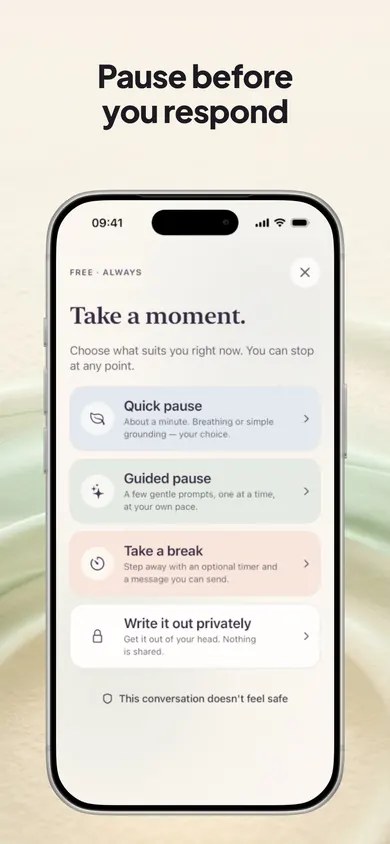
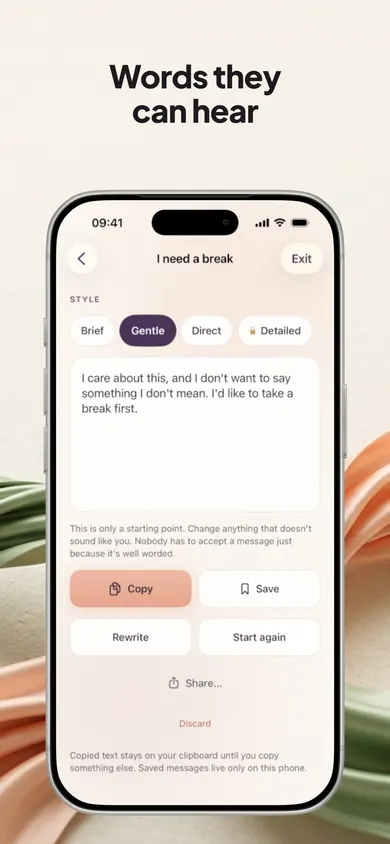
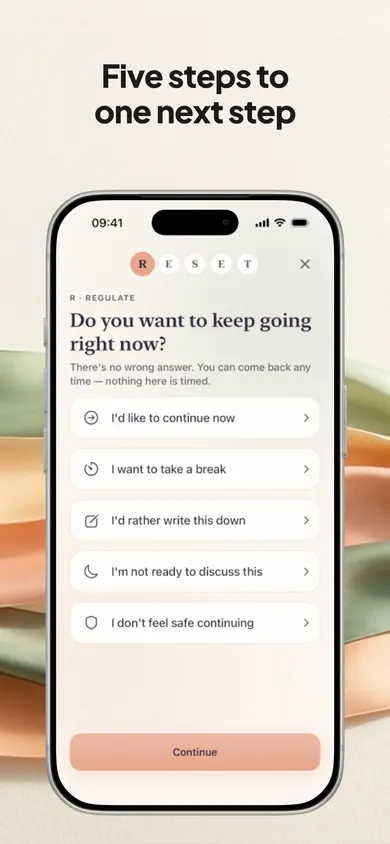
What the break looks like in UnFight
4 mistakes that turn a break into stonewalling
1Leaving without a word
Mistake[walks out, door closes]
FixI'm too worked up to listen well. I'm taking a break.
The Gottman Institute says to signal that you need a break, ideally with a sign you agreed on earlier. Silence with no signal looks exactly like punishment.
2No return time
MistakeI can't do this right now.
FixI need 30 minutes. I'll come find you at 9:15.
A time turns 'I'm done' into 'I'm coming back'. It also gives your partner something to hold while they wait.
3Using the break to build your case
Mistake[20 minutes drafting a better argument in your head]
Fix[20 minutes walking the dog, thinking about the dog]
Gottman's advice: do something soothing and distracting, and don't think about the situation or your partner. Rehearsing keeps your heart rate up.
4Not coming back
Mistake[9:15 passes. Then 10. Then bedtime.]
FixI'm calmer. Is now still OK, or would tomorrow morning be better?
A break that never ends is stonewalling with extra steps. Come back on time, even if only to agree a better time.
Name it. Time it. Calm down, not wind up. Come back.
Your return-time result, explained
The calculator in the header adds your break to the current time and writes the sentence for you. Twenty minutes is the floor, not a target: if you need an hour, say an hour. "Tomorrow" is allowed too, as long as you name when tomorrow. What the calculator cannot do is make you come back. Set a phone alarm for the time you said.
UnFight's break timer works the same way: 5, 20 or 30 minutes, custom, or no timer, with an optional private reminder and an editable message: "I want to continue this when I can give it my full attention. I'd like to take a break first." You choose whether to send it.
A mini story: 8:47 p.m., the dishes
You always do this. You just stop talking.
I'm not leaving the conversation. I'm too wound up to hear you right now. 20 minutes, then I'm back. 9:10.
Fine.
9:10 p.m.
OK. I'm calmer. Can I start with what I heard you say?
Nothing about the argument was solved at 8:47. What changed is that "you just stop talking" had a different ending this time. He walked around the block and did not rehearse a single comeback. She got a time instead of a closed door.
How it works in UnFight, in 3 steps
- Open it and pick what helps. The first question is "What would help right now?" Choose a quick pause, a guided pause or Take a break.
- Set the timer and the words. Pick 5, 20 or 30 minutes, custom or no timer. Edit the break message if you want to send one. Nothing is sent for you.
- Come back with a next step. When you return, Say It Right helps with words for the conversation, and the RESET method walks through it in five stages with no countdown.
One design decision we made: UnFight never sends anything on your behalf, not even the break message. A pause that arrives as an automated text would feel like exactly the withdrawal you are trying not to do.
- Honest limits: UnFight is a self-guided communication tool, not therapy or counseling, and it does not score your relationship. The break timer, Calm Down and Say It Right are free; unlimited guided RESET and Partner sessions are Premium.
- Who should pick something else: if arguments involve fear, threats or control, a break script is not the answer. Talk to The Hotline (US) or a local service. If you want a trained person in the room, look for a couples counselor.
Break vs stonewalling: questions couples ask
What is the difference between taking a break and stonewalling?
A break is named, timed and followed by a return: you say you need to stop, roughly when you will come back, and then you do. Stonewalling is withdrawing without any of that. The Gottman Institute describes stonewalling as disengaging and emotionally withdrawing from the interaction, and says stony silence is not neutrality or setting a boundary.
How long should a break during an argument be?
The Gottman Institute says a break should last at least twenty minutes, because that is about how long the body needs to calm down. Longer is fine if you say so. The part that matters is naming a return time and keeping it.
What should I do during the break?
Something soothing and distracting on your own: a walk, a shower, a dull task. Gottman's guidance is to avoid replaying the fight or rehearsing why you are right, because that keeps your body wound up.
What if my partner won't let me take a break?
Agree on the signal and the rule in a calm moment, not mid-fight. Many couples find it easier to accept a break when it comes with a time and a promise to come back. If you ever feel unsafe stopping or continuing, that is not a communication problem; reach out to a support line such as The Hotline.
Is going quiet always stonewalling?
No. Many people go quiet because they are flooded and cannot take anything else in. The difference is what happens next: saying 'I need a break, I'll be back at 9' turns silence into a pause with an end.
Does UnFight send the break message for me?
No. UnFight has an optional break timer (5, 20 or 30 minutes, custom, or no timer) and an editable message you can send yourself if you choose. Nothing is ever sent for you. The break timer is free and unlimited.
Take the break. Keep the promise.
The break timer is free and unlimited. Make it a habit with UnFight.

Updated November 2026
Related
- UnFight: make up after a fight, calmlyMake up after a fight with your partner: pause, find kinder words, agree one next step. UnFight is a private couples app, free on iPhone.
- When your husband shuts down mid-argument: myths vs factsWhy a husband goes silent mid-fight, what flooding is, and how a timed 20-minute break helps. Six myths checked against Gottman research.
- How to stop fighting with your partner during the holidaysFive visual steps for the fights couples have every December: money, whose family, the guest list, in-law comments and who does the work.
- Can a couples app replace couples therapy?Can a couples app replace therapy? What the research shows, what apps like Lasting, Paired and UnFight actually do, and when to see a therapist instead.